HAPPY INDEPENDENCE DAY TO EVERYONE!
Sorry for missing posts readers! Been "under the weather" for the past week.
As I've covered in several recent articles, the ethanol industry is "suffering" and more and more plants are being "idled". There is also growing pressure in Congress to limit the EPA's mandates on continuing to increase the number of gallons to be produced each year.
Here's yet another article describing the issues with the ethanol industry:
Peak
ethanol - so now what?
PEAK ethanol has
arrived. As an alternative to petroleum based fuel, ethanol has fallen off its
pedestal. After 15 years of growth, consumption in the US is starting to
decline and production plants are closing down.
The industry
invested heavily in new capacity based on assumptions that fuel consumption
would continue to rise and ethanol’s share would increase, underpinned by laws
requiring a certain proportion of ethanol to be blended into petrol. But petrol
consumption is not increasing and, with ethanol in the US now accounting for
almost 10 per cent of petrol supplies, the legal mandates have almost been
reached.
Meanwhile, the
ethanol industry's once powerful political support has weakened. Congress last
year eliminated about $6 billion in annual subsidies, and critics are pushing
for cuts in the 15 billion-gallon-a-year mandate. The industry’s plan to
increase the mandate to 15pc appears doomed.
The ethanol
industry consumes about 40pc of corn produced in the US, up from around 14pc in
2005, and has contributed to a big rise in corn prices. But with corn
production up and the change in ethanol’s fortunes, the reverse is now
occurring. The price of corn is back to where it was two years ago. Wheat and
barley, which are partial competitors, have gone the same way.
Peak ethanol
has also arrived in Australia. A campaign led by petrol retailers forced the
NSW government to back down on its plan to replace normal unleaded fuel with
E10, although the 6pc ethanol mandate was retained. With the focus now on gas,
there is little prospect it will rise again.
Ethanol’s
course has mirrored the economy, both in the US and here. With prosperity, all
sorts of indulgences can be accommodated. When times are tough, it’s back to
basics.
The idea that
fuel could be grown at home rather than imported from unfriendly foreign
countries appealed to a lot of people. Lining the pockets of Muammar Gaddafi or
Hugo Chavez was never going to win against that. Green groups also argued that
ethanol was renewable and produced fewer greenhouse gas emissions, while the
farm sector pointed to opportunities for “struggling farmers” to benefit from
increased demand for their crops.
There were some
who disagreed. The developing world pointed to the impact of higher food prices
on global hunger, with a UN official describing biofuels as a “crime against
humanity”. The industry responded by promising to shift to cellulosic feedstock
based on non-food crops grown on marginal land.
The elephant in
the room was always the fact that it is a lot more expensive to grow and
produce ethanol than it is to extract and refine petroleum, and cellulosic
ethanol is even more expensive. The only way ethanol can compete with petrol is
with government support. That has been forthcoming in the form of subsidies,
tax advantages and protection through mandated blending.
There is a cost
to this. Subsidies are a direct hit to the budget; tax advantages leave the
government with less revenue; and blending mandates impose extra costs on the
fuel industry. Ultimately the cost is borne by consumers, contributing to lower
economic growth. And that lowers tax revenue as well.
Governments are
beginning to reduce their support not because of sudden concerns about starving
people or the feeling that industries ought to stand on their own feet. Rather,
they can no longer afford to splash money around. They are under enormous
pressure to bring spending into line with revenue. If funding for the ethanol
industry is maintained, there will be less available for schools, hospitals,
roads and bridges.
This situation
will persist for quite a few years. The US and EU budget problems are too big
to be solved quickly, and neither has yet made a serious start anyway.
Australia’s debt is lower, but not insignificant. Unless there is a big
breakthrough in production costs, ethanol has no future as a major fuel.
The case for
greater energy self-sufficiency may have some merit, but ethanol is not the way
to achieve it. Australia has vast quantities of coal and natural gas (both
conventional and unconventional), plus potential for additional hydro power. On
the other hand, it does not have limitless land on which to grow food. Nor does
it have enough taxpayers to fund uncompetitive dreams. It is good that
ethanol’s best days are over.
David
Leyonhjelm is an agribusiness consultant with Baron Strategic Services. He may
be contacted atreclaimfreedom@gmail.com
"Pete" Landry..........comments welcome at .............way2gopete@yahoo.com
Tuesday, July 3, 2012

Tuesday, June 26, 2012
ANOTHER ETHANOL PLANT SHUTDOWN
The ethanol plants continue to struggle. Most plants are reporting their profits are "in the red", and several have shutdown. Here's another article of another plant shudown:
UPDATE 2-Ethanol sector braces for bad patch as Valero idles plant
Tue Jun 19, 2012 11:08pm GMT
By Michael Hirtzer and Carey Gillam
CHICAGO/KANSAS CITY, June 19 (Reuters) - The U.S. ethanol industry is hunkering down for another spell of deep losses, with a second producer temporarily shutting a Nebraska plant on Tuesday as diminishing corn supplies and lackluster gasoline demand crush profit margins.
Valero Energy Corp is idling its 110 million gallons (500 million liters) a year plant in Albion, Nebraska, but expects it to resume operations before the autumn corn harvest, when prices should start to ease and supplies become more plentiful, spokesman Bill Day said.
(Read full article here:
http://af.reuters.com/article/energyOilNews/idAFL1E8HJGCJ20120619?sp=true )
"Pete" Landry.........comments welcome at ........way2gopete@yahoo.com
Monday, June 25, 2012
GARBAGE FEEDING GARBAGE PLANT
Here's an interesting article I ran across...........communities sending their GARBAGE to an ethanol plant? Is this a case of "GARBAGE FEEDING GARBAGE"?
Hobart supports garbage-to-ethanol plant
By Karen Caffarini Post-Tribune
correspondent June 25, 2012 4:14PM
HOBART — The City Council has
unanimously approved an interlocal agreement to send Hobart-generated garbage
to the Powers Energy ethanol plant in Schneider, if and when it is
constructed, becoming the seventh community to commit to the project.
The
Joint Interlocal Cooperation Agreement is with the Lake County Solid Waste
Management District and the ethanol plant.
Earl
Powers of Evansville-based Powers Energy of America, who would develop and own
the plant, has asked for commitments from communities, saying they could help
him secure necessary funding.
The
Hobart council’s vote last week came after Cliff Duggan, attorney for Lake
County Solid Waste District, answered members’ questions about the feasibility
of the project and the status of other proposed trash-to-ethanol plants.
Duggan
said they should know by July 18 if the plant will be built. That is Powers’
deadline to show he has enough funding to build the plant.
Duggan
said so far six other communities have passed the agreement. The town of
Griffith rejected it; others are pending, he said. The St. John Town Council is
slated to vote on the agreement when it meets Thursday.
Councilman
Pete Mendez, D-2nd, asked how many other trash-to-energy facilities are
running. Duggan said the company has about 46 projects in various stages, and
one in Vero Beach, Fla., is about to start up.
Cost
has been a concern for some communities. Under the agreement, communities would
be able to remove themselves from the agreement if it became prohibitive for
them to continue to participate.
In
other matters, the council approved an interlocal agreement with the Recycling
& Waste Reduction District of Porter County that allows Porter County
residents to utilize the city’s latex paint recycling center.
Public
Works Director John Dubach said at the last council meeting that Porter County
residents will be able to bring in their old paint for free and buy the
recycled paint at the regular $3 a gallon price. All Lake County residents
currently are able to participate in the program.
Mendez
had recommended that out-of-county residents pay more for the paint, saying the
city spent $9,000 for the program and got back $3,000.
Mayor
Brian Snedecor said the initial ordinance provides for the $3 charge.
He
said if it turns out more people bring in paint than purchase it, the Porter
County Recycling and Waste District will be required to reimburse the city at a
cost of $3 per gallon.
“We
could explore the fee again at a later date.This agreement expires on Dec. 31,”
Snedecor said.
He
added the $9,000 expense includes some one-time costs.
"Pete" Landry.......comments welcome at "way2gopete@yahoo.com"
Sunday, June 24, 2012
New Article on 15% Ethanol Gasoline (Draft)
Readers, I'd like to share with you a new article I'm drafting for the website's "Ethanol Articles" page and also to submit to newspapers. It's still in draft form, and will likely undergo several revisions before it's complete. I'd like to hear back from my website readers what you think about the article. Is it of value to you? Is it clear or does it require greater detail or explanation? In this article, I'm really trying to educate and prepare the public for the new 15% ethanol gasoline, as it has the potential to do serious damage to certain types of gasoline powered equipment.
Here's the draft article:
In my continued research of E-15, I have learned that despite EPA’s claim that this new fuel is safe to use in all 2001 and newer passenger cars and light trucks, ALL automobile manufacturers, domestic and foreign alike, warn owners of 2001 and newer passenger cars and light trucks NOT to use gasoline with greater than 10% ethanol and further say that any damage caused by the use of gas with greater than 10% ethanol will void the vehicle warranty! E-15 should NEVER be used in vehicles model year 2000 or older as manufacturers warn that engine damage will likely occur. So, PLEASE read your owners manual carefully before considering putting this fuel in your 2001 or newer car or light truck, despite the EPA claim that it is safe. The ONLY vehicles which may use E-15 without the risk of damage are “Flex” vehicles, which are designed to tolerate all concentrations of ethanol, up to and including E-85 (85% ethanol/15% gasoline).
I am very concerned that despite pump label warnings, some consumers may be tempted to try this new fuel in equipment for which it is NOT designed. It will likely be priced about $0.10/gallon lower than E-10. But, don’t fall for the cheaper price temptation. As a reminder, here is the EPA approved label which EPA requires to appear on all pumps which will be selling 15% ethanol gasoline:
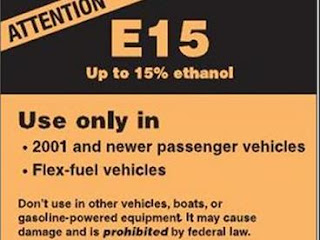
In addition to 2000 and older model passenger cars and light trucks, this fuel is also NOT COMPATIBLE with marine engines, motorcycles, four wheelers, jet skis, chain saws, all gas powered lawn and garden tools, gas powered home generators and all gasoline powered heavy duty engines like school buses, transit buses and delivery trucks. Use of E-15 in these engines may destroy the engines according to almost all manufacturers and warranties will NOT cover damages.
SO, when you pull up to a gas station and see the above new “E15” label on the pump, the old saying of “BUYER BEWARE” applies………use at your own risk! Use of this fuel in equipment it is not designed for may be very costly and the buyer may not have any recourse for damages that may result!
"Pete" Landry.......I'd really appreciate hearing from you about this draft article. E-mail me at ....way2gopete@yahoo.com and let me hear your thoughts on this draft.
Here's the draft article:
15% Ethanol Gasoline May Be in Stations by the End of 2012 By
Pete Landry – June 24, 2012
Readers of my
website (PeteLandrysRealGas.com) may recall I
wrote an article in 2011 about Growth Energy, a lobby group for a large group
of ethanol manufacturing plants in the Midwest petitioned the US Environmental
Protection Agency (EPA) in early 2009 to increase the ethanol content of motor
fuels from the current 10% maximum to 15%, a 50% increase (see the website’s “Ethanol
Articles” page for original article titled: “15% Ethanol Gasoline – A Potential
Crisis Developing”). The EPA allowed
input into this proposal and were inundated with replies, almost all
negative. Despite the response, the EPA
began testing vehicles with 15% ethanol.
In December, 2010, the EPA issued “conditional approval” for the use of
15% ethanol gasoline (E-15) in 2007 and newer cars and light trucks. Then, in January, 2011, they extended the
approval to use this new gasoline in 2001 thru 2006 cars and light trucks,
despite lawsuits against the EPA from over eight different groups. The biggest concern expressed by litigants was
the potential for “misfueling”, or using this gasoline in equipment which was
not designed to operate with this fuel.
In the EPA’s
approval of this new fuel, they made the following statement on their website:
What Vehicles and Engines MAY NOT USE E-15 ?
• All
motorcycles.
• All
vehicles with heavy-duty engines, such as school buses, transit buses, and
delivery trucks.
• All
off-road vehicles, such as boats and snowmobiles (includes four wheelers and
jet skis).
• All engines
in off-road equipment, such as lawnmowers (all lawn and garden tools) and chain
saws.
• All 2000
model-year and older cars (and light trucks).
(Gasoline
powered home generators cannot operate on E-15 gasoline either)
The EPA has
now completed all regulatory requirements necessary to authorize retailers to
sell this new fuel. Ethanol plants have
registered to become authorized to sell the ethanol to blenders. It is expected that E-15 may start showing up
in retail stations in Louisiana before the end of 2012. It is most likely this new fuel will be sold
in major, branded stations (Exxon/Mobil, Shell, Chevron, etc). Independent gas stations, grocery and convenience store have
expressed serious concerns about
the liability associated with selling this fuel when a customer’s
equipment is damaged, exposing them to lawsuits. The EPA indicates that it is VOLUNTARY, NOT MANDATORY for
stations to sell this new fuel. Retailers
are CAUTIONED NOT to let their gas supplier force
them into selling this fuel against their will.
Also, many grocery and convenience stores may have older underground
storage tanks and pumps which may not be compatible with E-15.
In my continued research of E-15, I have learned that despite EPA’s claim that this new fuel is safe to use in all 2001 and newer passenger cars and light trucks, ALL automobile manufacturers, domestic and foreign alike, warn owners of 2001 and newer passenger cars and light trucks NOT to use gasoline with greater than 10% ethanol and further say that any damage caused by the use of gas with greater than 10% ethanol will void the vehicle warranty! E-15 should NEVER be used in vehicles model year 2000 or older as manufacturers warn that engine damage will likely occur. So, PLEASE read your owners manual carefully before considering putting this fuel in your 2001 or newer car or light truck, despite the EPA claim that it is safe. The ONLY vehicles which may use E-15 without the risk of damage are “Flex” vehicles, which are designed to tolerate all concentrations of ethanol, up to and including E-85 (85% ethanol/15% gasoline).
I am very concerned that despite pump label warnings, some consumers may be tempted to try this new fuel in equipment for which it is NOT designed. It will likely be priced about $0.10/gallon lower than E-10. But, don’t fall for the cheaper price temptation. As a reminder, here is the EPA approved label which EPA requires to appear on all pumps which will be selling 15% ethanol gasoline:

In addition to 2000 and older model passenger cars and light trucks, this fuel is also NOT COMPATIBLE with marine engines, motorcycles, four wheelers, jet skis, chain saws, all gas powered lawn and garden tools, gas powered home generators and all gasoline powered heavy duty engines like school buses, transit buses and delivery trucks. Use of E-15 in these engines may destroy the engines according to almost all manufacturers and warranties will NOT cover damages.
SO, when you pull up to a gas station and see the above new “E15” label on the pump, the old saying of “BUYER BEWARE” applies………use at your own risk! Use of this fuel in equipment it is not designed for may be very costly and the buyer may not have any recourse for damages that may result!
"Pete" Landry.......I'd really appreciate hearing from you about this draft article. E-mail me at ....way2gopete@yahoo.com and let me hear your thoughts on this draft.
Saturday, June 23, 2012
HAVE A GREAT WEEKEND READERS!
Yet another article on the misery the ethanol industry is feeling these days. If this continues, we'll likely see more of the "corn ethanol" plants belly up. Couldn't happen too soon for me. This ethanol gas ruse is the worst thing ever perputated on the American public. We've been paying over $6 billion per year for over 10 years to support this industry. The notion that it reduces our import of crude oil is "poppycock". Due to the lower gas mileage on "corn gas", we have to fillup more frequently, so, it doesn't gain us anything.
Here's the latest article:
Bloomberg News
Ethanol Gains as Corn Posts Biggest Weekly Jump in 13 Months
By Mario Parker on June 22, 2012
Ethanol rose as corn capped the biggest weekly gain since May 2011 on speculation that warm, dry weather will stress crops next week.
The biofuel gained as the corn contract with the most interest soared 9.5 percent this week to $5.54 a bushel, raising the cost of ethanol production.
Producers are losing 8 cents on every gallon of ethanol made, according to data compiled by Bloomberg. Valero Energy Corp. (VLO) (VLO), the third-largest U.S. ethanol producer, this week idled output at its 110 million-gallon-a-year plant in Albion, Nebraska, as the biofuel struggles to keep pace with corn costs.
Denatured ethanol for July delivery rose 1.5 cents, or 0.7 percent, to $2.07 a gallon on the Chicago Board of Trade. Prices have fallen 6 percent this year.
In cash market trading, ethanol in the U.S. Gulf was unchanged at $2.125 a gallon and on the West Coast the biofuel added 0.5 cents, to $2.16, according to data compiled by Bloomberg.
Ethanol in New York jumped 1 cent, or 0.5 percent, to $2.09 a gallon and in Chicago the additive increased 0.5 cent to $2.05.
To contact the reporter on this story: Mario Parker in Chicago at mparker22@bloomberg.net
To contact the editor responsible for this story: Dan Stets at dstets@bloomberg.net
"Pete" Landry.........comments welcome at way2gopete@yahoo.com
Here's the latest article:
Bloomberg News
Ethanol Gains as Corn Posts Biggest Weekly Jump in 13 Months
By Mario Parker on June 22, 2012
Ethanol rose as corn capped the biggest weekly gain since May 2011 on speculation that warm, dry weather will stress crops next week.
The biofuel gained as the corn contract with the most interest soared 9.5 percent this week to $5.54 a bushel, raising the cost of ethanol production.
Producers are losing 8 cents on every gallon of ethanol made, according to data compiled by Bloomberg. Valero Energy Corp. (VLO) (VLO), the third-largest U.S. ethanol producer, this week idled output at its 110 million-gallon-a-year plant in Albion, Nebraska, as the biofuel struggles to keep pace with corn costs.
Denatured ethanol for July delivery rose 1.5 cents, or 0.7 percent, to $2.07 a gallon on the Chicago Board of Trade. Prices have fallen 6 percent this year.
In cash market trading, ethanol in the U.S. Gulf was unchanged at $2.125 a gallon and on the West Coast the biofuel added 0.5 cents, to $2.16, according to data compiled by Bloomberg.
Ethanol in New York jumped 1 cent, or 0.5 percent, to $2.09 a gallon and in Chicago the additive increased 0.5 cent to $2.05.
To contact the reporter on this story: Mario Parker in Chicago at mparker22@bloomberg.net
To contact the editor responsible for this story: Dan Stets at dstets@bloomberg.net
"Pete" Landry.........comments welcome at way2gopete@yahoo.com
Thursday, June 21, 2012
Yet Another Indication of Ethanol Plants Struggling to Make a Profit
Here's yet another article on the ethanol plant struggles. Most are no longer profitable and are searching for ways to diversify in hopes of returning to profitability. The poor economy, consumers driving less due to both the economy and high gas prices, plus loss of the ethanol $0.45/gallon tax subsidy are wreaking havoc on the ethanol industry. Then, Congress is more and more leaning to reign in the out of control EPA on this issue.
Here's the article:
UPDATE 1-Struggling ethanol makers diversify to corn oil
"Pete" Landry..........comments welcome at way2gopete@yahoo.com
Here's the article:
UPDATE 1-Struggling ethanol makers diversify to corn oil
Thu Jun 21, 2012 5:32pm GMT
*
Pacific Ethanol adds corn oil to ethanol business
* US ethanol producers make 4.69 mln lbs of corn oil daily
* Diversification needed to offset weak ethanol margins
By Carey Gillam
June 21 (Reuters) - Pacific Ethanol
Inc on Thursday said it was launching a corn oil business, the latest U.S.
ethanol maker to move to diversify its revenue stream in an industry where
margins have been depressed as costly corn supplies dwindle.
California-based Pacific Ethanol
said it was installing corn oil separation technology at one plant and planned
to do so at its three other plants by the first quarter of 2013. The company
said its corn oil business should start generating revenue in the first quarter
of 2013.
(Read full article here: https://news.google.com/news/story?ncl=d4MdFIx2pbgvWRMUf8mD1TKLZkOoM&hl=en&ned=us"Pete" Landry..........comments welcome at way2gopete@yahoo.com
Wednesday, June 20, 2012
Ethanol Industry in Trouble
Hello readers.........here's yet another article showing that the ethanol industry is in trouble. Several plants have shutdown and many others are operating in the "red". Their greatest concern is that the US Congress are finally beginning to have lingering thoughts on the EPA's mandates on ethanol gasoline. All I can say, "it's about time". When even Al Gore said it was a mistake to start this business, you know it's not what it was cooked up to be.
Here's the article:
Oil lobby biggest threat to U.S. ethanol: RFA leader By Christine Stebbins
CHICAGO | Wed Jun 20, 2012 4:57pm EDT
(Reuters) - The biggest threat to U.S. ethanol makers, now struggling with negative profit margins, is not high corn prices but possible changes to the renewable fuel policy by Washington legislators, the top ethanol industry executive said on Wednesday.
"This year is tough. Our biggest challenge though is more about Capitol Hill and threats to policy than the markets and threats to profitability," Bob Dinneen, chief executive of the Renewable Fuels Association, told Reuters on-line grain forum.
The 2007 U.S. energy policy's renewable fuels standard (RFS), mandates annual production of 15 billion gallons of ethanol by 2015 for energy independence. By 2022, RFS calls for 36 billion gallons of renewable fuels, including cellulosic biofuels.
U.S. ethanol production in 2011 was 13.9 billion gallons of which more than a billion gallons was exported.
Dinneen said he was pleased by Friday's approval by the Environmental Protection Agency (EPA) to allow the sale of fuel containing 15 percent ethanol, up from the current 10 percent for vehicles 2001 and newer. But said the oil industry clearly sees ethanol as unwelcomed competition.
"I'm seeing a far more aggressive oil lobby going after the RFS in every forum possible," said Dinneen, citing a lawsuit against EPA over cellulosic numbers and the introduction of anti-RFS amendments to the Farm Bill.
"That speaks volumes as to the lengths oil is prepared to go to undermine this important policy. I do not believe they will be successful," Dinneen added.
NEGATIVE ETHANOL MARGINS, E15 HOPES
Ethanol markers have been hurt this spring by tight grain supplies, which has pushed up the cost of corn, an ethanol feedstock. The soft economy has also weakened demand for gasoline, which is blended with ethanol. Profit margins are running anywhere from 25 to 35 cents per gallon in the red, trade sources say.
"This is most definitely a challenging market, and some plants that might not be as well positioned in the market as others may well look at closing for a bit until this bumper crop comes in. It's really no different than the oil industry that sees production capacity change with the market," he said.
In the past week two Nebraska plants, Nedak Ethanol in Atkinson and Valero Energy (VLO.N) in Albion, temporarily shut down. Both cited high corn prices and negative margins. In April, Archer Daniels Midland (ADM.N) permanently closed its Walhalla, North Dakota plant for similar reasons.
The announcements raised painful reminders of 2008 when the financial markets crash sent ethanol profits plummeting and many producers filed for bankruptcy including VeraSun Energy.
"In my mind, 2008 was a different year. Operating capital was more difficult to secure, if not impossible. Gasoline prices were relatively higher," Dinneen said. "But it was an equally challenging year, just different issues."
"I sure don't see a rash of permanent closures. There may be more consolidation coming to the industry," he added.
But Dinneen remains "bullish" on ethanol as demand for the product stays strong, including exports, which Dinneen said should at least match the record 1.1 billion gallons sold in 2011.
Dinneen also expects the sale of E15 to give the industry a boost, with Iowa, Illinois and Kansas to be among the first states to offer the blend.
A shortage of ethanol pumps at rural filling stations and a push back from retailers who fear lawsuits if car engines fail make adoption of E15 an uphill climb, ethanol makers say.
"The E15 market will grow slowly of course, limited by blendstock availability and the constraints EPA has placed on the product," Dinneen said. "Certainly by September when volatility regulations are removed, E15 should begin to grow more rapidly."
(Reporting by Christine Stebbins; Editing by Bob Burgdorfer)
"Pete" Landry........comments welcome at way2gopete@yahoo.com
Here's the article:
Oil lobby biggest threat to U.S. ethanol: RFA leader By Christine Stebbins
CHICAGO | Wed Jun 20, 2012 4:57pm EDT
(Reuters) - The biggest threat to U.S. ethanol makers, now struggling with negative profit margins, is not high corn prices but possible changes to the renewable fuel policy by Washington legislators, the top ethanol industry executive said on Wednesday.
"This year is tough. Our biggest challenge though is more about Capitol Hill and threats to policy than the markets and threats to profitability," Bob Dinneen, chief executive of the Renewable Fuels Association, told Reuters on-line grain forum.
The 2007 U.S. energy policy's renewable fuels standard (RFS), mandates annual production of 15 billion gallons of ethanol by 2015 for energy independence. By 2022, RFS calls for 36 billion gallons of renewable fuels, including cellulosic biofuels.
U.S. ethanol production in 2011 was 13.9 billion gallons of which more than a billion gallons was exported.
Dinneen said he was pleased by Friday's approval by the Environmental Protection Agency (EPA) to allow the sale of fuel containing 15 percent ethanol, up from the current 10 percent for vehicles 2001 and newer. But said the oil industry clearly sees ethanol as unwelcomed competition.
"I'm seeing a far more aggressive oil lobby going after the RFS in every forum possible," said Dinneen, citing a lawsuit against EPA over cellulosic numbers and the introduction of anti-RFS amendments to the Farm Bill.
"That speaks volumes as to the lengths oil is prepared to go to undermine this important policy. I do not believe they will be successful," Dinneen added.
NEGATIVE ETHANOL MARGINS, E15 HOPES
Ethanol markers have been hurt this spring by tight grain supplies, which has pushed up the cost of corn, an ethanol feedstock. The soft economy has also weakened demand for gasoline, which is blended with ethanol. Profit margins are running anywhere from 25 to 35 cents per gallon in the red, trade sources say.
"This is most definitely a challenging market, and some plants that might not be as well positioned in the market as others may well look at closing for a bit until this bumper crop comes in. It's really no different than the oil industry that sees production capacity change with the market," he said.
In the past week two Nebraska plants, Nedak Ethanol in Atkinson and Valero Energy (VLO.N) in Albion, temporarily shut down. Both cited high corn prices and negative margins. In April, Archer Daniels Midland (ADM.N) permanently closed its Walhalla, North Dakota plant for similar reasons.
The announcements raised painful reminders of 2008 when the financial markets crash sent ethanol profits plummeting and many producers filed for bankruptcy including VeraSun Energy.
"In my mind, 2008 was a different year. Operating capital was more difficult to secure, if not impossible. Gasoline prices were relatively higher," Dinneen said. "But it was an equally challenging year, just different issues."
"I sure don't see a rash of permanent closures. There may be more consolidation coming to the industry," he added.
But Dinneen remains "bullish" on ethanol as demand for the product stays strong, including exports, which Dinneen said should at least match the record 1.1 billion gallons sold in 2011.
Dinneen also expects the sale of E15 to give the industry a boost, with Iowa, Illinois and Kansas to be among the first states to offer the blend.
A shortage of ethanol pumps at rural filling stations and a push back from retailers who fear lawsuits if car engines fail make adoption of E15 an uphill climb, ethanol makers say.
"The E15 market will grow slowly of course, limited by blendstock availability and the constraints EPA has placed on the product," Dinneen said. "Certainly by September when volatility regulations are removed, E15 should begin to grow more rapidly."
(Reporting by Christine Stebbins; Editing by Bob Burgdorfer)
"Pete" Landry........comments welcome at way2gopete@yahoo.com
Subscribe to:
Posts (Atom)